

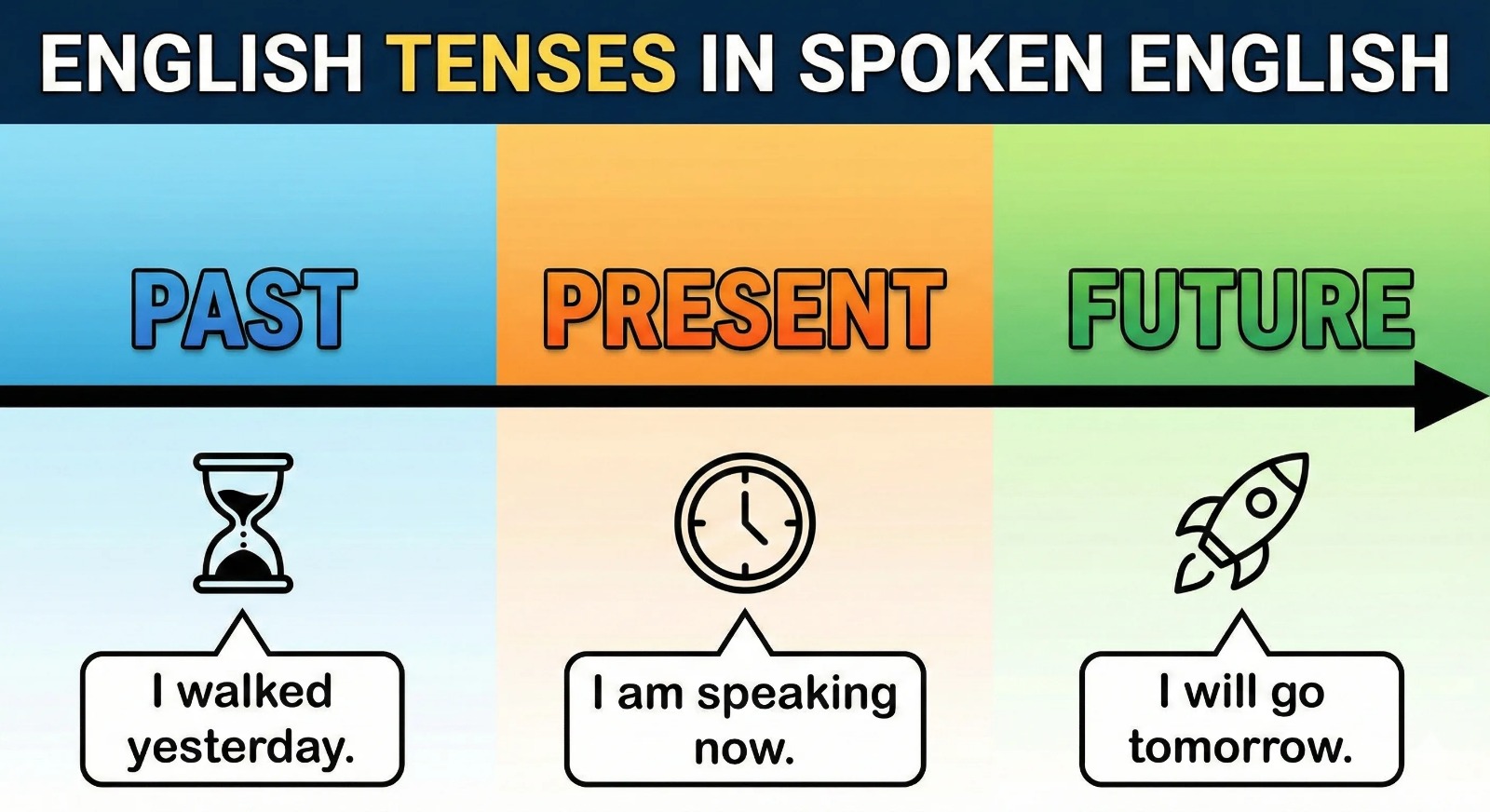
English grammar plays a vital role in clear and confident communication, and tenses are one of its most important components. Whether we are speaking about the past, present, or future, tenses help us convey when an action happens. In spoken English especially, correct use of tenses ensures that the listener understands the message accurately. This blog explains what tenses are and how they are used in everyday spoken English.
What Is Tense in English Grammar?
Tense refers to the time of an action or event expressed in a sentence. It tells us when something happens—whether it happened in the past, is happening now, or will happen in the future.
In English, tenses are mainly divided into three basic categories:
- Present Tense
- Past Tense
- Future Tense
Each of these has further forms that show different aspects of time and action.
Types of Tenses and Their Use in Spoken English
- Present Tense
The present tense is commonly used in daily conversations. It talks about current actions, habits, general truths, and ongoing situations.
Uses in spoken English:
- Talking about daily routines
- Expressing facts and habits
- Describing actions happening now
Examples:
- I work in an office.
- She speaks English fluently.
- I am learning spoken English.
- Past Tense
The past tense is used to describe actions that are already completed. In spoken English, it is often used to share experiences, stories, or past events.
Uses in spoken English:
- Talking about past experiences
- Sharing stories or memories
- Describing completed actions
Examples:
- I visited Australia last year.
- He completed his course.
- We watched a movie yesterday.
- Future Tense
The future tense expresses actions that will happen later. In spoken English, people often use simple forms to talk about plans, decisions, or predictions.
Uses in spoken English:
- Talking about future plans
- Making promises or predictions
- Expressing intentions
Examples:
- I will call you tomorrow.
- She is going to start a new job.
- We will meet next week.
Why Are Tenses Important in Spoken English?
- Clarity in Communication
Correct use of tenses helps listeners understand when an action happened, is happening, or will happen. This avoids confusion in conversations.
- Builds Confidence While Speaking
When learners use tenses correctly, they speak more fluently and confidently. It reduces hesitation and fear of making mistakes.
- Improves Sentence Structure
Understanding tenses helps speakers form grammatically correct sentences, making their speech more natural and professional.
- Essential for Everyday Conversations
From casual talks to professional discussions, tenses are used everywhere. Even simple conversations rely heavily on correct tense usage.
- Helps in Exams and Interviews
Spoken English exams, interviews, and presentations assess tense usage. Proper tense control improves overall language performance.
Common Tense Mistakes in Spoken English
- Mixing past and present tenses incorrectly
- Overusing future tense with “will”
- Forgetting verb forms
- Using wrong auxiliary verbs
Regular practice helps overcome these errors.
Tips to Use Tenses Correctly in Spoken English
- Practice speaking daily using simple sentences
- Start with basic tenses before advanced forms
- Listen to native speakers and observe tense usage
- Practice storytelling to improve past tense
- Speak slowly and focus on accuracy
Conclusion
Tenses are the backbone of English grammar and play a crucial role in spoken English. They help speakers express time clearly, communicate confidently, and avoid misunderstandings. By understanding and practicing tenses regularly, learners can improve their spoken English significantly and communicate more effectively in everyday life.
Mastering tenses is not about memorizing rules but about using them naturally through regular speaking practice.
About the Author Mrs. Debie Avilaa Westcott Founder & Director, THE IMMACULATE Mrs. Debie Avilaa Westcott is the Founder and Director of THE IMMACULATE, Chennai’s leading institute for IELTS training and study abroad guidance. With over two decades of experience in education and international admissions, she has helped thousands of students achieve their global dreams through expert coaching and mentorship.
Thanks and Regards,
Debie Avilaa Westcott
Your overseas search ends here!