

Importance of Listening and Speaking Skills in Communication:-
Introduction
Communication is the foundation of human interaction. It enables individuals to share ideas, express emotions, exchange information, and build relationships. Whether in personal life, education, or professional environments, effective communication determines how well people understand one another. Communication is not limited to the act of speaking alone; it is a two-way process that involves both sending and receiving messages. Among the various components of communication, listening and speaking skills play a vital role.
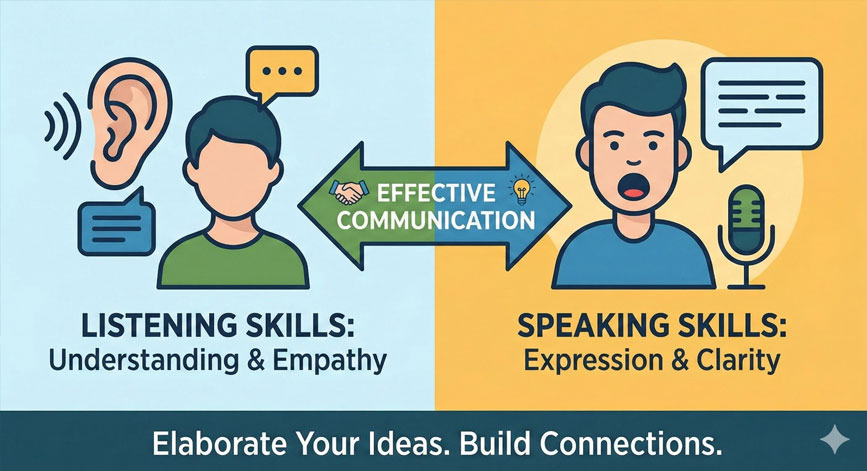
Listening and speaking are often referred to as oral communication skills, and they are inseparable. Speaking allows individuals to express their thoughts, opinions, and feelings, while listening enables them to understand, interpret, and respond appropriately to others. Without effective listening, speaking becomes ineffective, and without clear speaking, listening loses its purpose. Together, these skills ensure clarity, mutual understanding, and meaningful interaction.
In today’s fast-paced and interconnected world, the importance of listening and speaking skills has increased significantly. From classrooms and workplaces to social interactions and global communication, these skills influence success, leadership, teamwork, and relationships. This essay elaborates on the importance of listening and speaking skills in communication, their role in various aspects of life, challenges faced in developing them, and ways to improve these essential skills.
Understanding Communication
Communication is the process of exchanging information, ideas, and emotions between individuals or groups through verbal and non-verbal means. It involves several elements such as the sender, message, medium, receiver, and feedback. Effective communication occurs when the receiver understands the message in the same way the sender intended.
Listening and speaking are central to this process. Speaking represents the expressive aspect of communication, while listening represents the receptive aspect. Both are equally important and must function together to ensure successful communication. Poor listening or unclear speaking can lead to misunderstandings, conflicts, and communication breakdowns.
Importance of Listening Skills in Communication:-
- Listening as the Foundation of Communication
Listening is not merely hearing sounds; it is an active process that involves paying attention, understanding, interpreting, and responding to spoken messages. Effective listening forms the foundation of communication because it ensures that messages are correctly received and understood.
When people listen attentively, they can grasp not only the words being spoken but also the emotions, intentions, and underlying meanings. This leads to accurate responses and meaningful conversations. Without good listening skills, communication becomes incomplete and ineffective.
- Enhancing Understanding and Clarity
Listening skills help in gaining a clear understanding of the speaker’s message. In academic and professional settings, attentive listening ensures that instructions, concepts, and information are properly understood. This reduces errors, confusion, and the need for repeated explanations.
For example, students who listen carefully in classrooms are more likely to understand lessons, perform better in exams, and participate effectively in discussions. Similarly, employees who listen well can follow instructions accurately and complete tasks efficiently.
- Building Strong Relationships
Effective listening plays a crucial role in building and maintaining healthy relationships. When individuals feel listened to, they feel valued, respected, and understood. This strengthens trust and emotional connections.
In personal relationships, listening allows people to empathize with others’ feelings and perspectives. In professional relationships, it promotes cooperation, teamwork, and mutual respect. Good listeners are often seen as supportive and reliable individuals.
- Encouraging Empathy and Emotional Intelligence
Listening enhances empathy by allowing individuals to understand others’ emotions and viewpoints. Through attentive listening, one can recognize feelings such as happiness, frustration, or concern, even when they are not explicitly stated.
This emotional awareness is a key component of emotional intelligence. Empathetic listeners respond thoughtfully and sensitively, which helps in resolving conflicts and strengthening interpersonal bonds.
- Improving Decision-Making and Problem-Solving
Effective listening contributes to better decision-making and problem-solving. By listening to different opinions, ideas, and feedback, individuals can evaluate situations more accurately and make informed choices.
In workplaces, leaders who listen to employees’ suggestions and concerns can identify problems early and develop effective solutions. In group discussions, active listening ensures that all perspectives are considered before reaching a conclusion.
Importance of Speaking Skills in Communication:-
- Expressing Ideas Clearly and Confidently
Speaking skills enable individuals to express their thoughts, ideas, and opinions clearly and confidently. Effective speaking involves using appropriate words, tone, and body language to convey messages accurately.
Clear speaking reduces misunderstandings and ensures that the intended message is delivered effectively. Confidence in speaking also enhances credibility and makes communication more persuasive and impactful.
- Enhancing Academic and Professional Success
Strong speaking skills are essential for success in education and careers. In academic settings, students are required to participate in discussions, deliver presentations, and express their understanding verbally. Good speaking skills help them communicate their knowledge effectively and gain confidence.
In professional environments, speaking skills are crucial for interviews, meetings, negotiations, and leadership roles. Employees who communicate well are more likely to be recognized, promoted, and trusted with responsibilities.
- Developing Leadership and Influence
Effective speakers often emerge as leaders because they can inspire, motivate, and guide others. Speaking skills allow leaders to articulate visions, provide direction, and address concerns clearly.
A leader who speaks confidently and persuasively can influence others’ attitudes and actions. Public speaking, in particular, plays a significant role in leadership, advocacy, and social change.
- Facilitating Social Interaction
Speaking skills are essential for social interaction and everyday communication. From casual conversations to formal discussions, the ability to speak clearly and politely helps individuals connect with others.
Good speaking skills improve social confidence and help individuals express themselves comfortably in various situations. This contributes to positive social experiences and personal growth.
- Supporting Cultural and Global Communication
In a globalized world, speaking skills are vital for cross-cultural communication. Clear and respectful speech helps bridge cultural differences and promotes mutual understanding.
Effective speaking also involves adapting language, tone, and style to suit different audiences. This adaptability is essential in international communication, diplomacy, and global business.
Relationship Between Listening and Speaking Skills:-
Listening and speaking are interconnected and complementary skills. Effective communication requires a balance between both. A good communicator listens attentively before responding thoughtfully. Similarly, clear speaking encourages better listening from others.
When listening and speaking skills work together, communication becomes more interactive and meaningful. Feedback, clarification, and dialogue are possible only when both skills are actively used. Neglecting one skill weakens the overall communication process.
Role of Listening and Speaking Skills in Different Contexts:-
- In Education
Listening and speaking skills are fundamental to learning. Students must listen to teachers, peers, and lectures to acquire knowledge. Speaking allows them to ask questions, participate in discussions, and present ideas.
Teachers with strong speaking skills can explain concepts clearly, while good listening helps them understand students’ needs and difficulties.
- In the Workplace
In professional environments, effective communication improves productivity, teamwork, and workplace harmony. Listening helps employees understand tasks and feedback, while speaking allows them to share ideas and concerns.
Organizations that encourage open communication benefit from innovation, collaboration, and employee satisfaction.
- In Personal Life
In personal relationships, listening and speaking skills foster understanding, trust, and emotional support. Honest and respectful communication helps resolve conflicts and strengthen bonds between individuals.
- In Society
Listening and speaking skills contribute to active citizenship and social participation. Public discussions, debates, and community interactions depend on effective oral communication.
Good communication promotes tolerance, cooperation, and peaceful coexistence in society.
Challenges in Developing Listening and Speaking Skills:-
Despite their importance, many individuals face challenges in developing effective listening and speaking skills. Common barriers include lack of confidence, fear of public speaking, distractions, language barriers, and poor listening habits.
Modern technology and multitasking have also reduced attention spans, making active listening more difficult. Overcoming these challenges requires awareness, practice, and continuous improvement.
Ways to Improve Listening and Speaking Skills:-
- Practice active listening by focusing fully on the speaker and avoiding distractions.
- Ask questions and provide feedback to ensure understanding.
- Expand vocabulary and language skills to improve clarity in speaking.
- Practice speaking regularly through discussions, presentations, and conversations.
- Develop confidence by preparing and rehearsing before speaking.
- Observe good communicators and learn from their techniques.
- Seek feedback to identify areas for improvement.
Conclusion
Listening and speaking skills are essential components of effective communication. They enable individuals to express ideas clearly, understand others accurately, and build meaningful relationships. Listening fosters empathy, understanding, and cooperation, while speaking enhances confidence, leadership, and influence.
In education, workplaces, personal relationships, and society at large, strong listening and speaking skills contribute to success, harmony, and growth. In a world where communication is increasingly important, developing these skills is not optional but necessary.
By consciously improving listening and speaking abilities, individuals can become better communicators, leaders, and global citizens. Effective communication begins with listening carefully and speaking thoughtfully, making these skills indispensable in every aspect of life.
About the Author Mrs. Debie Avilaa Westcott Founder & Director, THE IMMACULATE Mrs. Debie Avilaa Westcott is the Founder and Director of THE IMMACULATE, Chennai’s leading institute for IELTS training and study abroad guidance. With over two decades of experience in education and international admissions, she has helped thousands of students achieve their global dreams through expert coaching and mentorship.
Thanks and Regards,
Debie Avilaa Westcott
Your overseas search ends here!