

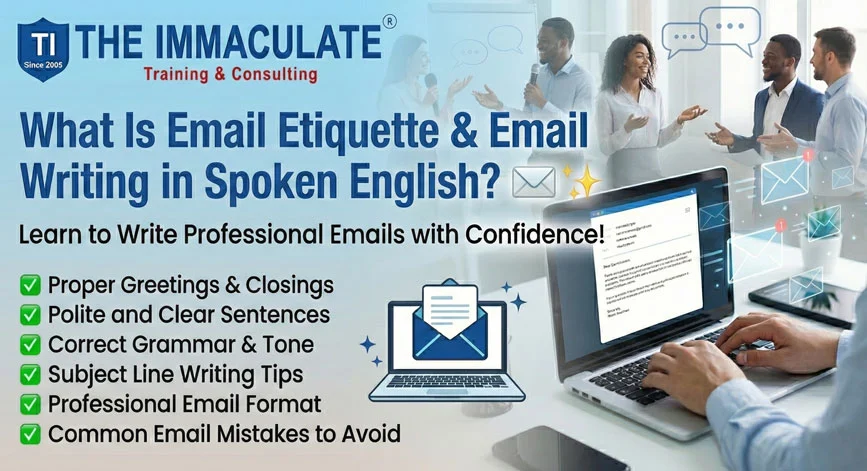
In today’s digital world, email remains one of the most powerful and widely used communication tools. Whether you are a student, job seeker, employee, entrepreneur, or business owner, the way you write an email shapes how others perceive you. A well-written email reflects professionalism, clarity, confidence, and respect. On the other hand, a poorly written email can damage relationships, create confusion, and even affect career opportunities.
This blog explores what email etiquette is, why it matters, and how email writing connects with spoken English skills. It also provides practical structures, examples, and tips to help you communicate effectively in academic and professional settings.
1. What Is Email Etiquette?
Email etiquette refers to the set of guidelines and best practices that govern polite, professional, and effective communication through email. Just like face-to-face conversations require manners, tone, and clarity, email communication also follows certain standards.
Email etiquette includes:
• Using appropriate greetings and closings
• Writing clear subject lines
• Maintaining a respectful tone
• Avoiding slang or overly casual language in formal emails
• Responding within a reasonable time
• Structuring content logically
• Checking grammar and spelling
In simple terms, email etiquette is about communicating clearly while showing professionalism and courtesy.
2. Why Is Email Etiquette Important?
2.1 First Impressions Matter
Often, your email is the first interaction someone has with you. Whether applying for a job, contacting a professor, or communicating with a client, your email represents you before you speak.
A well-written email shows:
• Confidence
• Organization
• Respect
• Attention to detail
2.2 Prevents Misunderstanding
Unlike spoken communication, emails do not include facial expressions or tone of voice. Poorly structured sentences or unclear wording can easily cause confusion. Proper email etiquette ensures clarity.
2.3 Reflects Professionalism
In workplaces and academic institutions, email communication is formal documentation. Employers and educators expect structured and polite communication.
2.4 Builds Strong Relationships
Polite and thoughtful emails build trust and long-term professional relationships.
3. What Is Email Writing in Spoken English?
Email writing in spoken English refers to writing emails that are clear, natural, and conversational while maintaining professionalism. It means writing in a tone that feels human and approachable — similar to how you would speak politely in person — but without becoming too informal.
For example:
❌ Too formal:
“I hereby request the submission of the aforementioned documents at your earliest convenience.”
✅ Natural spoken English style:
“Could you please send the documents at your earliest convenience?”
The second example sounds natural, polite, and professional.
4. Differences Between Spoken English and Email Writing
While emails may sound conversational, they are not exactly the same as spoken English.
Spoken English Email Writing
Includes gestures and tone Relies only on words
Often informal Usually structured
Immediate feedback Delayed response
Can include fillers like “um” or “you know” Must avoid unnecessary fillers
Email writing requires clarity, structure, and correct grammar, but it can still sound natural.
5. Structure of a Professional Email
Every professional email generally follows a clear structure:
5.1 Subject Line
The subject line should be clear and specific.
Examples:
• “Application for Marketing Internship”
• “Request for Meeting – Project Update”
• “Inquiry About Course Enrollment”
Avoid vague subjects like:
• “Important”
• “Hello”
• “Request”
A clear subject helps the recipient understand the purpose immediately.
5.2 Greeting
Choose greetings based on the situation:
Formal:
• Dear Mr. Smith,
• Dear Ms. Johnson,
• Dear Professor Brown,
Semi-formal:
• Hello John,
• Hi Sarah,
If unsure about the person’s gender:
• Dear Alex Taylor,
Avoid:
• Hey!
• Hi dude
5.3 Opening Line
Start with a polite introduction.
Examples:
• I hope you are doing well.
• I am writing to inquire about…
• Thank you for your time.
• I am reaching out regarding…
5.4 Main Body
The body should:
• Be clear and concise
• Stay focused on one topic
• Use short paragraphs
• Avoid long, complicated sentences
Example:
“I am interested in applying for the internship position mentioned on your website. I have attached my resume and would appreciate the opportunity to discuss my application further.”
5.5 Closing Line
End politely:
• I look forward to your response.
• Thank you for your time and consideration.
• Please let me know if you need further information.
5.6 Sign-Off
Formal:
• Best regards,
• Sincerely,
• Kind regards,
Informal:
• Thanks,
• Best,
Then include:
• Your full name
• Contact information
6. Types of Emails
6.1 Formal Emails
Used for:
• Job applications
• Academic communication
• Business communication
• Complaints
• Official requests
Tone: Professional and respectful.
6.2 Semi-Formal Emails
Used for:
• Colleagues
• Clients you know well
• Teachers you regularly interact with
Tone: Professional but friendly.
6.3 Informal Emails
Used for:
• Friends
• Family
• Close contacts
Tone: Casual and relaxed.
7. Common Email Writing Mistakes
7.1 No Subject Line
Emails without subject lines may be ignored.
7.2 Poor Grammar
Example:
❌ “I am interested for this job.”
✅ “I am interested in this job.”
7.3 Writing in All Capital Letters
THIS LOOKS LIKE SHOUTING.
7.4 Overuse of Emojis in Professional Emails
Avoid:
“Thank you 😊😊😊”
7.5 Long Paragraphs
Large blocks of text are difficult to read. Break them into short paragraphs.
8. Email Tone and Politeness in Spoken English Style
Tone is extremely important.
Instead of writing:
“Send me the report today.”
Write:
“Could you please send me the report by today?”
Adding polite expressions makes a big difference:
• Could you please…
• I would appreciate it if…
• Would you mind…
• Kindly…
• Thank you for…
These phrases reflect spoken English politeness patterns.
9. Email Writing for Students
Students frequently write emails to:
• Professors
• Admission offices
• Internship coordinators
• Scholarship committees
Example (Student to Professor):
Subject: Request for Assignment Extension
Dear Professor Lee,
I hope you are doing well. I am writing to request a short extension for the assignment due on Friday, as I have been unwell this week. I would greatly appreciate an additional two days to complete it.
Thank you for your understanding.
Best regards,
Rahul Sharma
This example is polite, clear, and structured.
10. Email Writing for Job Applications
When applying for jobs:
• Mention the position clearly
• Keep the message concise
• Attach required documents
• Use a professional email address
Avoid email addresses like:
• coolguy123@email.com
Use:
• firstname.lastname@email.com
11. Importance of Clarity in Email Writing
Clarity avoids confusion.
Instead of:
“I was thinking maybe we could discuss it sometime.”
Write:
“Could we schedule a meeting on Thursday at 3 PM to discuss the proposal?”
Specific communication saves time.
12. Role of Grammar in Email Writing
Correct grammar builds credibility.
Important grammar areas:
• Tenses
• Subject-verb agreement
• Prepositions
• Articles
• Polite modal verbs (could, would, may)
Example:
❌ “He don’t know about the meeting.”
✅ “He doesn’t know about the meeting.”
13. Email Response Etiquette
Good email etiquette also includes replying properly:
• Respond within 24–48 hours
• Acknowledge receipt if necessary
• Answer all questions asked
• Maintain the same tone
Example:
“Thank you for your email. I have received the documents and will review them by tomorrow.”
14. Cultural Sensitivity in Email Communication
Different cultures have different communication styles. In international settings:
• Avoid overly direct language
• Be respectful
• Avoid humor that may be misunderstood
• Use neutral language
Professional communication should always be culturally sensitive.
15. Email Writing Practice Tips
To improve email writing:
1. Read professional emails regularly.
2. Practice writing sample emails.
3. Learn formal vocabulary.
4. Improve grammar knowledge.
5. Ask for feedback.
6. Edit before sending.
Always review:
• Spelling
• Attachments
• Recipient’s name
• Tone
16. Email Writing vs Chat Communication
Email is more structured than:
• Text messages
• Whats App messages
• Social media chats
Avoid using:
• Abbreviations (LOL, BTW, ASAP in formal context)
• Slang
• Incomplete sentences
Emails are often permanent records and should be treated seriously.
17. Advanced Email Writing Skills
For higher-level communication:
• Use clear transitions (Furthermore, Additionally, However)
• Keep a professional tone
• Be concise but complete
• Use bullet points when needed
• Maintain logical flow
18. The Power of Simplicity
Professional emails do not require complicated vocabulary. Clear and simple language is more effective.
Instead of:
“Kindly expedite the aforementioned documentation.”
Write:
“Please send the documents as soon as possible.”
Simple language improves understanding.
19. How Email Writing Improves Spoken English
Practicing email writing:
• Strengthens grammar
• Improves sentence formation
• Expands vocabulary
• Enhances clarity
• Builds confidence
When you write clearly, you also begin to speak clearly.
20. Final Thoughts
Email etiquette and email writing in spoken English are essential life skills in modern communication. Whether you are a student, professional, or entrepreneur, mastering email writing helps you present yourself confidently and professionally.
Remember:
• Be clear
• Be polite
• Be professional
• Be concise
A well-written email opens doors, builds relationships, and creates opportunities. Strong communication skills are not optional anymore — they are essential.
About the Author Mrs. Debie Avilaa Westcott Founder & Director, THE IMMACULATE Mrs. Debie Avilaa Westcott is the Founder and Director of THE IMMACULATE, Chennai’s leading institute for IELTS training and study abroad guidance. With over two decades of experience in education and international admissions, she has helped thousands of students achieve their global dreams through expert coaching and mentorship.
Thanks and Regards,
Debie Avilaa Westcott
Your overseas search ends here!