

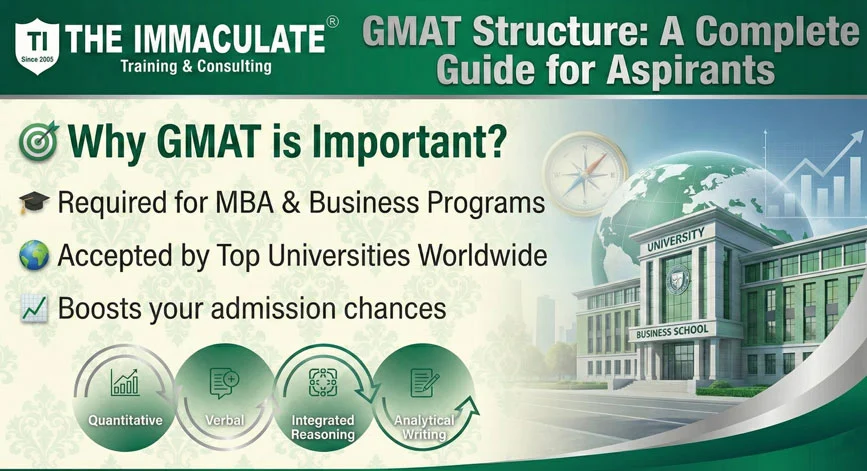
The Graduate Management Admission Test (GMAT) is one of the most recognized entrance exams for business schools worldwide. If you are planning to pursue an MBA, Master in Management, or other graduate business programs, understanding the structure of the GMAT is the first step toward achieving a competitive score.
At THE IMMACULATE Training and Consulting, we believe that mastering the structure of the GMAT is just as important as mastering the content. Many students struggle not because they lack ability, but because they do not fully understand how the exam is designed. This comprehensive guide will break down the GMAT structure, scoring system, question types, preparation strategy, and expert insights to help you approach the test with clarity and confidence.
What is the GMAT?
The GMAT is a standardized exam designed to assess analytical, quantitative, verbal, and data interpretation skills required for success in graduate business programs. It is widely accepted by leading business schools across the world.
The test evaluates how well you can:
• Analyze data
• Solve quantitative problems
• Interpret written material
• Think critically
• Make logical decisions
Business schools use GMAT scores as a standardized measure to compare applicants from diverse academic and professional backgrounds.
At THE IMMACULATE Training and Consulting, we guide students not just to take the exam — but to strategically use their GMAT performance to strengthen their MBA applications.
Overview of the Current GMAT Structure
The GMAT has evolved in recent years. The latest version, known as the GMAT Focus Edition, is more streamlined and skill-focused.
Total Duration:
Approximately 2 hours and 15 minutes (excluding optional breaks)
Total Questions:
64 questions
Sections:
1. Quantitative Reasoning
2. Verbal Reasoning
3. Data Insights
Each section is carefully designed to measure practical decision-making skills relevant to business leadership.
Section 1:
Quantitative Reasoning
Duration:
45 minutes
Number of Questions:
21 questions
Question Types:
• Problem Solving
This section measures your ability to analyze data and solve quantitative problems using mathematical reasoning.
Key Topics Covered:
• Arithmetic
• Algebra
• Word Problems
• Ratios and Proportions
• Percentages
• Exponents
• Linear Equations
• Inequalities
• Statistics
• Data Interpretation
The Quantitative section does not allow the use of a physical calculator. However, an on-screen calculator is available for certain parts of the exam.
Skills Tested:
• Logical reasoning
• Mathematical interpretation
• Analytical thinking
• Decision-making under time pressure
At THE IMMACULATE Training and Consulting, we train students to focus on accuracy and time management. The GMAT Quant section is not about advanced mathematics — it is about applying fundamental concepts efficiently.
Section 2:
Verbal Reasoning
Duration:
45 minutes
Number of Questions:
23 questions
Question Types:
• Reading Comprehension
• Critical Reasoning
The Verbal section measures your ability to understand written material, evaluate arguments, and draw logical conclusions.
Reading Comprehension
You will read passages related to business, economics, science, and social sciences. Questions test:
• Main idea identification
• Inference
• Tone and structure
• Supporting details
Critical Reasoning
These questions present arguments. You must:
• Strengthen an argument
• Weaken an argument
• Identify assumptions
• Evaluate evidence
• Draw logical conclusions
At THE IMMACULATE Training and Consulting, we emphasize structured reading strategies, logical mapping techniques, and argument breakdown methods to help students maximize their verbal scores.
Section 3:
Data Insights
Duration:
45 minutes
Number of Questions:
20 questions
This is the most distinctive part of the updated GMAT structure. It combines skills from both quantitative and verbal reasoning.
Question Formats Include:
• Data Sufficiency
• Multi-Source Reasoning
• Table Analysis
• Graphics Interpretation
• Two-Part Analysis
Skills Measured:
• Data evaluation
• Interpretation of charts and graphs
• Logical sufficiency analysis
• Multi-layered decision-making
Data Insights reflects real-world business scenarios where professionals must interpret information from multiple sources before making decisions.
At THE IMMACULATE Training and Consulting, we train students to approach Data Insights strategically, focusing on logic rather than calculation-heavy methods.
Adaptive Nature of the GMAT
The GMAT is a computer-adaptive test at the section level. This means:
• The difficulty of questions adjusts based on your performance.
• Each section adapts independently.
If you answer questions correctly, the next set may become more challenging. If you answer incorrectly, the difficulty may decrease slightly.
Because of this adaptive format:
• Early accuracy is crucial.
• Guessing randomly can impact your overall score.
• Consistency matters more than speed alone.
Our expert trainers at THE IMMACULATE Training and Consulting teach students how to manage adaptive testing strategies effectively.
GMAT Scoring Structure
Total Score Range:
205 to 805
Each section contributes to your total score.
Section Scores:
• Quantitative Reasoning
• Verbal Reasoning
• Data Insights
Business schools primarily focus on the overall score but also consider sectional balance.
What Is a Good GMAT Score?
• 650+ is considered competitive for many business schools.
• 700+ is strong for top global programs.
• 750+ is considered exceptional.
However, the definition of a “good score” depends on your target schools and overall profile.
At THE IMMACULATE Training and Consulting, we help students set realistic score targets aligned with their MBA ambitions.
Time Management in GMAT
Time pressure is one of the biggest challenges in the GMAT.
You have approximately:
• 2 minutes per question in Quant
• Around 2 minutes per question in Verbal
• Slightly over 2 minutes per question in Data Insights
Poor time management can negatively impact adaptive scoring.
We train our students to:
• Identify time-consuming traps
• Skip strategically
• Avoid perfectionism
• Maintain pacing discipline
Effective timing strategies often increase scores significantly.
Common Mistakes Students Make
1. Ignoring the Structure
Many students start practicing without understanding how the exam flows.
2. Over-Focusing on One Section
Balanced preparation is essential.
3. Neglecting Data Insights
This section requires a different approach compared to traditional quant or verbal.
4. Poor Mock Test Analysis
Practice without review does not lead to improvement.
At THE IMMACULATE Training and Consulting, we ensure students follow a structured preparation plan with detailed performance analysis.
How to Prepare Strategically
Step 1: Diagnostic Test
Take a full-length mock exam to identify strengths and weaknesses.
Step 2: Concept Building
Strengthen fundamentals in quant and verbal.
Step 3: Sectional Practice
Focus on improving weak areas.
Step 4: Full-Length Mock Tests
Simulate real test conditions.
Step 5: Performance Review
Analyze mistakes deeply — understand why errors occurred.
Our structured GMAT coaching program at THE IMMACULATE Training and Consulting is designed to guide students through each of these steps methodically.
Why GMAT Structure Matters for MBA Aspirants
Business schools value the GMAT because it measures:
• Analytical reasoning
• Problem-solving
• Data interpretation
• Communication clarity
• Decision-making under pressure
Understanding the structure helps you align your preparation with what business schools truly value.
GMAT vs. Other Exams
While some business schools accept other exams, the GMAT remains highly respected due to its:
• Business-focused structure
• Data interpretation emphasis
• Analytical rigor
• Global recognition
Many competitive MBA programs still prefer GMAT scores for applicants aiming for finance, consulting, or analytics roles.
Test Day Experience
The GMAT is conducted at authorized test centers or online.
You should:
• Arrive early
• Carry valid identification
• Stay calm
• Follow pacing strategy
Confidence on test day comes from preparation familiarity.
At THE IMMACULATE Training and Consulting, we provide mock simulations to reduce exam anxiety.
Retake Policy
Students can retake the GMAT if unsatisfied with their score.
However:
• Preparation strategy must change before retaking.
• Repeating the same mistakes leads to similar results.
We provide score evaluation and improvement plans for students considering a retake.
Final Thoughts
The GMAT structure is carefully designed to evaluate not just academic knowledge but business readiness. It tests your ability to think critically, interpret data, and solve problems efficiently — skills that are essential for success in MBA programs and corporate leadership roles.
Understanding the GMAT structure gives you a powerful advantage. Instead of feeling overwhelmed, you gain clarity, direction, and strategic focus.
At THE IMMACULATE Training and Consulting, we specialize in structured preparation, personalized mentoring, and performance-driven coaching. Our goal is not just to help you pass the GMAT — but to help you achieve a score that strengthens your MBA application and opens doors to global business schools.
If you are planning to take the GMAT and aim for top business schools, let THE IMMACULATE Training and Consulting guide you toward excellence with expert mentorship and proven strategies.
Your journey to a global MBA begins with understanding the exam — and mastering it.
About the Author Mrs. Debie Avilaa Westcott Founder & Director, THE IMMACULATE Mrs. Debie Avilaa Westcott is the Founder and Director of THE IMMACULATE, Chennai’s leading institute for IELTS training and study abroad guidance. With over two decades of experience in education and international admissions, she has helped thousands of students achieve their global dreams through expert coaching and mentorship.
Thanks and Regards,
Debie Avilaa Westcott
Your overseas search ends here!