

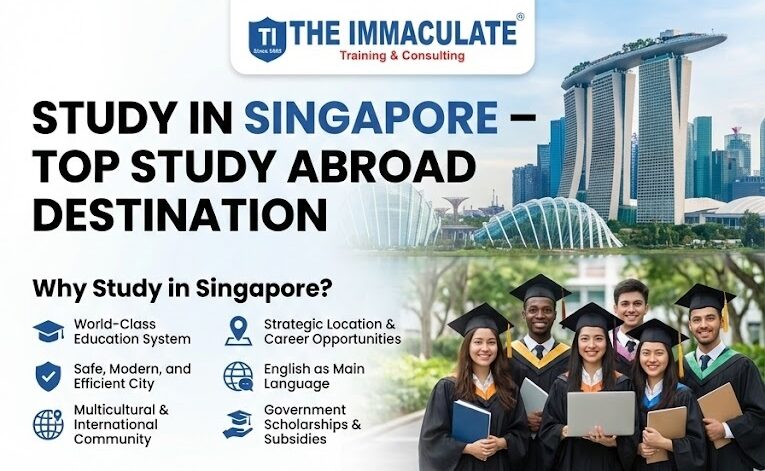
Why Study in Singapore ?
Given below are 4 important aspects of Studying in Singapore.
🏠 2. Living Expenses (per year)
💰 3. Scholarships and Financial Aid
🔍 Summary: Is Singapore Cheaper?
🔍 Top Hiring Industries for Graduates
- What Singapore offers in terms of education.
- Comparison of Tuition Fees
- Subject-wise tuition fees breakdown
- 4 Comparison of job prospects and average starting salaries
- World-Class Education System
- Globally ranked universities: Institutions like the National University of Singapore (NUS) and Nanyang Technological University (NTU) consistently rank among the top universities in the world.
- Strong focus on STEM, business, and innovation.
- Singaporean education emphasizes critical thinking, practical skills, and global relevance.
- Strategic Location & Career Opportunities
- A gateway to Asia, especially for industries like finance, tech, logistics, and biotech.
- Many multinational companies have regional headquarters in Singapore, offering strong internship and job prospects.
- Easy access to ASEAN countries, China, and India for future work or travel.
- Safe, Modern, and Efficient City
- One of the safest countries in the world, with low crime and strict laws.
- Excellent public transport, healthcare, and infrastructure.
- High quality of life with a mix of urban modernity and nature.
- English as the Main Language of Instruction
- No language barrier for most international students.
- All major universities use English as the medium of instruction, making it accessible to a global student body.
- Multicultural & International Community
- A blend of Chinese, Malay, Indian, and Western cultures, creating a vibrant and inclusive environment.
- Great exposure to different perspectives and intercultural communication skills.
- Government Scholarships and Subsidies
- Various scholarships available for international students (e.g., ASEAN scholarships, government-funded options).
- Tuition Grant Scheme reduces costs for eligible international students (with a work obligation after graduation).
- Amazing Food & Cultural Scene
- A UNESCO-recognized street food culture at affordable prices.
- Diverse cultural festivals, museums, and art scenes.
| Country | Average Tuition (USD/year) | Range (USD) | Notes |
| Singapore | $12,000 – $25,000 (with subsidy) $20,000 – $45,000 (without subsidy) | Subsidized rates available via Tuition Grant Scheme (work bond of 3 years after graduation) | |
| Australia | $20,000 – $40,000 | Up to $55,000 for medicine/law | Higher for postgraduate or specialized degrees |
| UK | $15,000 – $35,000 | Medical degrees: $40,000+ | 3-year degrees usually; some shorter programs save money |
| US | $25,000 – $55,000 | Elite private universities: $70,000+ | Public universities cheaper for in-state, but not for internationals |
| Country | Average Living Cost (USD/year) | Notes |
| Singapore | $10,000 – $15,000 | Shared housing, public transport, subsidized meals |
| Australia | $15,000 – $22,000 | Depends on city (Sydney/Melbourne are pricier) |
| UK | $15,000 – $20,000 | London is most expensive |
| US | $15,000 – $25,000 | Highly variable (NYC, California = high cost) |
| Country | Scholarship Availability | Notes |
| Singapore | High (Merit-based + Gov’t Tuition Grant) | Competitive but generous |
| Australia | Moderate | Offered by unis and gov’t (e.g., Australia Awards) |
| UK | Moderate | Commonwealth & Chevening scholarships for postgrad |
| US | High at top schools, but highly competitive | Some need-based aid at elite private universities |
- ✅ Singapore is generally more affordable than the US, UK, or Australia when:
- You receive a tuition grant (which includes a 3-year work commitment).
- You manage housing through hostels or student accommodations.
- ❗ Without subsidies, costs approach those in other developed countries.
- 💼 But the return on investment is strong due to lower cost of living and better regional career opportunities in Asia.
- Subject-wise tuition fees breakdown
- Without Tuition Grant: USD $31,000 – $38,000 / year
- With Tuition Grant: USD $10,000 – $12,000 / year
- Duration: 4 years
- Popular Majors: Mechanical, Electrical, Computer, Civil, Chemical
- Notes: Strong focus on innovation, research, and tech internships.
- Without Tuition Grant: USD $85,000 – $90,000 / year
- With Tuition Grant: USD $28,000 – $35,000 / year
- Duration: 5 years
- Universities: NUS Yong Loo Lin School of Medicine, Duke-NUS (post grad only)
- Notes: Very competitive admission; grants come with longer work bonds (up to 5–6 years).
- Without Tuition Grant: USD $30,000 – $40,000 / year
- With Tuition Grant: USD $10,000 – $12,000 / year
- Duration: 3–4 years
- Popular Programs: BBA, Finance, Accounting, Business Analytics
- Notes: High employability with internships in global firms (esp. finance, consulting).
- Without Tuition Grant: USD $28,000 – $33,000 / year
- With Tuition Grant: USD $9,000 – $11,000 / year
- Duration: 3–4 years
- Notes: Strong in biotech, environmental science, and applied research.
- Without Tuition Grant: USD $32,000 – $40,000 / year
- With Tuition Grant: USD $10,000 – $12,000 / year
- Duration: 4 years
- Notes: High demand; top-notch AI, cyber security, and software engineering programs.
- Without Tuition Grant: USD $37,000 – $45,000 / year
- With Tuition Grant: USD $12,000 – $14,000 / year
- Duration: 4 years
- University: NUS Faculty of Law
- Notes: Only a few seats for international students; highly competitive.
- Without Tuition Grant: USD $25,000 – $30,000 / year
- With Tuition Grant: USD $8,000 – $10,000 / year
- Duration: 3–4 years
- Examples: Psychology, Sociology, Economics, History, Communications
- Tuition Grant (from Singapore Ministry of Education) is available to most international students but comes with a 3-year work obligation in a Singapore-based company (not necessarily in your field).
- Living costs are ~USD $10,000 – $15,000/year, depending on lifestyle and housing.
- Scholarships (merit-based) may further reduce costs and do not always include a bond.
| Subject Area | Employment Rate (%) | Avg Starting Salary (USD/month) | Notes |
| Computer Science / IT | 92–95% | $3,800 – $5,000 | High demand in fintech, software, AI. Skills in Python, cloud, data science valued. |
| Engineering | 88–93% | $3,400 – $4,300 | Civil, mechanical, and electrical engineers needed; higher salaries for computer/electrical. |
| Business / Management | 90–94% | $3,300 – $4,200 | Finance, consulting, marketing roles. SMU & NUS grads in finance get higher salaries. |
| Medicine | ~100% (bonded) | $4,500 – $6,000 | Excellent job security; long work bond (~5 years). Mostly for locals or PRs. |
| Law | 85–90% | $3,800 – $5,500 | Competitive jobs in top law firms. Some firms prefer locals/PRs. |
| Sciences (Bio/Chem/Phys) | 80–85% | $2,800 – $3,500 | Lower starting pay; higher demand in R&D or biotech if paired with postgrad. |
| Social Sciences / Humanities | 80–88% | $2,800 – $3,400 | Jobs in HR, education, public policy, media. Salaries improve with work experience. |
| Design / Arts | 75–85% | $2,500 – $3,200 | Graphic design, UX/UI in demand. Freelance or contract roles common. |
- Tech: Grab, Google, Shopee, GovTech, Amazon
- Finance: DBS, UOB, Standard Chartered, JP Morgan
- Engineering & Logistics: ST Engineering, SIA, PSA, Keppel
- Consulting: McKinsey, BCG, Accenture
- Public Sector: Ministries, Statutory Boards (e.g., IMDA, EDB)
- Tech graduates consistently see the highest employment and salary growth.
- Business grads with internships or analytics skills (Excel, SQL, Python) are highly employable.
- Medicine and law offer strong long-term security, but may have visa or PR constraints for foreign students.
- Soft skills + internships are critical across all majors for job readiness in Singapore.
About the Author Mrs. Debie Avilaa Westcott Founder & Director, THE IMMACULATE Mrs. Debie Avilaa Westcott is the Founder and Director of THE IMMACULATE, Chennai’s leading institute for IELTS training and study abroad guidance. With over two decades of experience in education and international admissions, she has helped thousands of students achieve their global dreams through expert coaching and mentorship.